Posts

Proof Concerning Central Line \(X_5X_6\) of Triangle

Image
Hello everyone. Today we will prove theorem about central line \(X_5X_6\) of triangle. Proof of the Central Line in a Golden Rectangle Construction Statement of the Theorem Let \(ABCD\) be a golden rectangle where \( \frac{AB}{BC} = \phi \), and construct the square \( BCQP \) inside it. Reflect \( P \) over \( D \) to obtain \( E \). Then, the line \( EB \) coincides with the central line \( X_5X_6 \) of triangle \( ABP \). Step-by-Step Proof 1. Define the Coordinates We assign coordinates as follows: \( A = (0,0) \), \( B = (\phi x, 0) \), \( C = (\phi x, x) \), \( D = (0, x) \). The square \( BCPQ \) ensures \( P = (\phi x, 2x) \). The reflection of \( P \) across \( D \) is \( E = (-\phi x, 2x) \). 2. Compute the Nine-Point Center \( X_5 \) The nine-point center \( X_5 \) is the circumcenter of the medial triangle, which consists of the midpoints: \[ M_1 = \left(\frac{0 + \phi x}{2}, 0\right) = \left(\frac{\phi x}{2}, 0\right), \] \[ M_2 = \left(\f...

Proof Concerning Central Line \(X_5X_6\) of Triangle

Image
Hello everyone. Today we will prove theorem about central line \(X_5X_6\) of triangle. Proof of the Central Line in a Golden Rectangle Construction Statement of the Theorem Let \(ABCD\) be a golden rectangle where \( \frac{AB}{BC} = \phi \), and construct the square \( BCQP \) inside it. Reflect \( P \) over \( D \) to obtain \( E \). Then, the line \( EB \) coincides with the central line \( X_5X_6 \) of triangle \( ABP \). Step-by-Step Proof 1. Define the Coordinates We assign coordinates as follows: \( A = (0,0) \), \( B = (\phi x, 0) \), \( C = (\phi x, x) \), \( D = (0, x) \). The square \( BCPQ \) ensures \( P = (\phi x, 2x) \). The reflection of \( P \) across \( D \) is \( E = (-\phi x, 2x) \). 2. Compute the Nine-Point Center \( X_5 \) The nine-point center \( X_5 \) is the circumcenter of the medial triangle, which consists of the midpoints: \[ M_1 = \left(\frac{0 + \phi x}{2}, 0\right) = \left(\frac{\phi x}{2}, 0\right), \] \[ M_2 = \left(\f...
Proof of the Area Relation in Right-Angled Triangle and Extouch Triangles

Image
Hello everyone. Today we will prove theorem about area relation in right-angled triangle and extouch triangles. Theorem Statement Let \( ABC \) be a right-angled triangle with the right angle at \( C \). Consider its associated special triangles: The intouch triangle \( A_0B_0C_0 \) formed by the contact points of the incircle. The extouch triangles \( A_1B_1C_1 \), \( A_2B_2C_2 \), and \( A_3B_3C_3 \), corresponding to the excircles touching \( BC \), \( AC \), and \( AB \) respectively. Denote their respective areas as \( T_0, T_1, T_2, \) and \( T_3 \). Then, the areas satisfy the relation: \[ T_3 = T_0 + T_1 + T_2. \] Proof Basic Notation Let: \( a, b, c \) be the sides of \( \triangle ABC \), where \( c \) is the hypotenuse. \( s \) be the semiperimeter: \[ s = \frac{a + b + c}{2}. \] \( r \) be the inradius (radius of the incircle). \( r_A, r_B, r_C \) be the exradii opposite to \( A, B, C \), respectively. The area ...

Proof of the Theorem Regarding Golden Ratio

Image
 Hello everyone. Today we will prove theorem regarding construction of the golden ratio. Theorem: Given isosceles triangle \(ABC\) with angle of \(30^{\circ}\) at vertex \(C\) , inscribed rectangle \(DEFG\) ,whose side \(DE\) is twice side \(EF\), with a side \(FG\) along the base side \(AB\) . If the side \(DE\) is extended to intersect the circumcircle at \(P\), then \(E\) divides \(DP\) in the golden ratio. Proof: We prove that \( E \) divides \( DP \) in the golden ratio, i.e., \[\frac{DP}{DE} = \frac{DE}{EP} = \phi,\] where \( \phi = \frac{1+\sqrt{5}}{2} \). Coordinate System We place the circumcircle of \( \triangle ABC \) with center at the origin \( O(0,0) \) and radius \( R \).     \( C \) is at \( (0, R) \).     \( A \) and \( B \) lie symmetrically along the \( x \)-axis. Using trigonometry, the coordinates of \( A \) and \( B \) are: \[A = \left(-\frac{\sqrt{3}}{2}R, -\frac{1}{2}R \right), \quad B = \...

Proof of the product formula for \(\dfrac{\pi}{2\sqrt{3}}\)

  Hello everyone.  Today we will prove the product formula for  \(\dfrac{\pi}{2\sqrt{3}}\).  We will use the method of direct proof as a proof method.  Theorem 1:  \[\frac{\pi}{2\sqrt{3}}=\displaystyle\sum_{n=1}^{\infty}\frac{\chi(n)}{n}\]\[\text{where} \quad \chi(n)=\begin{cases} 1, & \text{if } n \equiv 1 \pmod{6}\\-1, & \text{if } n \equiv -1 \pmod{6}\\0, & \text{otherwise}\end{cases}\] Theorem 2:  We have\[\frac{\pi}{2\sqrt{3}}=\frac{5 \cdot 7 \cdot 11 \cdot 13 \cdot 17 \cdot 19 \cdot 23 \cdot 29 \cdots}{6 \cdot 6 \cdot 12 \cdot 12 \cdot 18 \cdot 18 \cdot 24 \cdot 30 \cdots}\]expression whose numerators are the sequence of the odd prime numbers greater than \(3\) and whose denominators are even–even numbers one unit more or less than the corresponding numerators. Proof: By Theorem 1 we know that \[\frac{\pi}{2\sqrt{3}}=1-\frac{1}{5}+\frac{1}{7}-\frac{1}{11}+\frac{1}{13}-\frac{1}{17}+\frac{1}{19}-\cdots\] we will have \[\frac{1}{5} \cdo...

Proof that \(I_0(\sqrt{2})\) is an irrational number

   Hello everyone.  Today we will prove that   \(I_0(\sqrt{2})\) is an irrational number, where \( I_0\) denotes a modified Bessel function of the first kind. We will use the method of contradiction as a proof method. Theorem 1:    \(I_0(\sqrt{2})=\displaystyle\sum_{n=0}^{\infty} \frac{1}{(n!)^22^n}\) Theorem 2:    \(I_0(\sqrt{2})\)   is an irrational number. Proof: Suppose that  \(I_0(\sqrt{2})\)  is a rational number. Then  \(I_0(\sqrt{2})\)  can be written in the form \( \dfrac{p}{q} \) where \( p \)  and \( q\) are coprime integers such that \(q \ge 1\). By Theorem 1 we can write the following equality: \(q!(q-1)!p2^q=\displaystyle\sum_{n=0}^{\infty} \frac{(q!)^22^q}{(n!)^22^n}\) . Since left hand side of this equality is an integer the sum \(\displaystyle\sum_{n=q+1}^{\infty} \frac{(q!)^22^q}{(n!)^22^n}\) which is greater than zero \(0\)  also must be an integer. Clearly for \(n \ge q+1\) we have , \(\...

Proof that the set of prime numbers is infinite

Hello everyone. Today we will prove that the set of prime numbers is infinite.  We will use the method of contradiction as a proof method.  We'll also use the theorem of French mathematician Eduardo Lucas.  Theorem (Lucas): Every prime factor of Fermat number \(F _ n = 2 ^ {2 ^ n} + 1\); (\(n > 1\)) is of the form \(k2 ^{n + 2} + 1\).  Theorem: The set of prime numbers is infinite. Proof: Suppose opposite, that there are just finally many prime numbers and we denote the largest prime by \(p\). Then \(F_p\) must be a composite number because \(F_p>p\). By Lucas theorem we know that there is a prime number \(q\) of the form \(k2 ^{p + 2} + 1\) that divides \(F_p\). But \(q>p\) , thus we arrived at  a contradiction. Hence, the set of prime numbers is infinite. \(\blacksquare\)

Proof that a natural number can be expressed as a product of prime numbers

Hello everyone.  Today we will prove that any natural number greater than \(1 \) can be expressed as a product of a prime number and number one or as a product of few prime numbers.  We will use the method of mathematical induction as a proof method.  Theorem: Let \(n \) be a natural number greater than \(1 \).  Then \(n \) can be expressed as the product of one prime number and number one or as the product of few prime numbers. Proof: Note that if \(n \) is a prime number, the statement is automatically proved because any number can be written as the product of that number and number one.  1. Base case (n = 2)  Since \(2 \) is a prime number the statement is automatically proved.  2. Induction hypothesis (n = m)  Suppose that \(\forall k \in \mathbb {N}, \quad 2 \le k \le m \), \(k \) can be expressed as the product of a prime number and number one or as a product of few prime numbers.  3. Inductive step (n = m + 1)  Using the assum...

Proof of the theorem regarding Fibonacci prime numbers

Hello everyone.  Today we will prove the theorem regarding Fibonacci prime numbers.  We will use the method of contradiction as a proof method.  Theorem: Let \(F_n \) be the nth Fibonacci number and let \(F_n \) be a prime number.  Then \(n \) is also a prime number, except in the case of \(F_4 = 3 \).  Proof:   For the case when \(n = 2 \) we have that \(F_2 = 1 \), and as we know the number \(1 \) is neither simple nor composite, so this case does not refute the truth of the theorem.  For the case when \(n = 3 \) we have that \(F_3 = 2 \), so this case is in accordance with the statement.  Now, suppose that for \(n> 4 \), \(F_n \) is a prime number and that \(n = rs \) for some natural numbers \(r, s \) which are greater than \(1 \), that is, that \(n \) is a composite number.  Since \(n> 4 \)  at least one of the numbers \(r \) and \(s \) is greater than \(2 \).  Then, according to the divisibility theorem of Fibonacci ...

Proof of the formula for the sum of the first n Fibonacci numbers

Hello everyone.  Today we will prove the formula for the sum of the first \(n \) Fibonacci numbers.  We will use the method of mathematical induction as a proof method.  Theorem: \(\forall n \in \mathbb {N} _0, \quad \displaystyle \sum_ {j = 0} ^ nF_j = F_ {n + 2} -1 \)  Proof:   1. Base case (n = 0)  \[\displaystyle \sum_ {j = 0} ^ 0F_j = F_ {2} -1 \] \[F_ {0} = F_ {2} -1 \] \[0 = 1-1 \] \[0 = 0 \]  2. Induction hypothesis (n = m)  Suppose that: \[\displaystyle \sum_ {j = 0} ^ mF_j = F_ {m + 2} -1 \]  3. Inductive step (n = m + 1)  Using the assumption from the second step, we will prove that: \[\displaystyle \sum_ {j = 0} ^ {m + 1} F_j = F_ {m + 3} -1 \]  So,  \[\displaystyle \sum_ { j = 0} ^ {m + 1} F_j = \displaystyle \sum_ {j = 0} ^ {m} F_j + F_ {m + 1} = \] \[F_ {m + 2} -1 + F_ {m +1} = \] \[F_ {m + 1} + F_ {m + 2} -1 = \] \[F_ {m + 3} -1 \] \(\blacksquare\)

Proof of the formula for the area of a circle

Hello everyone.  Today we will prove the formula for the area of ​​a circle.  We will use the method of direct proof as a proof method.  Theorem: Denote by \(P \) the area of ​​a circle and by \(r \) the radius of a circle.  Then the following equation holds: \(P = r ^ 2 \pi \)  Proof:   The equation of a circle in Cartesian  coordinate system is \(x ^ 2 + y ^ 2 = r ^ 2 \).  Hence we have that \(y = \pm \sqrt {r ^ 2-x ^ 2} \).  Based on the geometric interpretation of a certain integral, it follows: \[P = \int \limits _ {- r} ^ r \left(\sqrt {r ^ 2-x ^ 2} - \left (- \sqrt {r ^ 2-x ^ 2} \right) \right) \, dx \]  So, \[P = \int \limits _ {- r} ^ r 2 \sqrt {r ^ 2-x ^ 2} \, dx \] \[P = \int \limits _ {- r} ^ r 2 \sqrt {r ^ 2 \left (1- \frac {x ^ 2} {r ^ 2} \right)} \, dx \] \[P = \int \limits _ {- r} ^ r 2r \sqrt {1- \frac {x ^ 2} {r ^ 2}} \, dx \]  Let us now introduce the substitution \(x = r \cos \theta \).  Hence, we have t...

Proof of the formula for the nth derivative of the natural logarithm

Hello everyone.  Today we will prove the formula for the nth derivative of the natural logarithm.  We will use the method of mathematical induction as a proof method.  Theorem: The nth derivative of the function \(\ln (x) \) for \(n \ge 1 \) is given by the formula: \[\frac {\mathrm {d} ^ n} { \mathrm {d} x ^ n} \ln (x) = \frac {(n-1)! (-1) ^ {n-1}} {x ^ n} \]  Proof:  1. Base case (n = 1) \[\frac {\mathrm {d}} {\mathrm {d} x} \ln (x) = \frac {(1-1)! (-1) ^ {1-1}} {x ^ 1} \] \[ \frac {1} {x} = \frac {(0)! (-1) ^ {0}} {x} \] \[\frac {1} {x} = \frac {1} {x} \]  2. Induction hypothesis (n = m)  Suppose that:  \[\frac{\mathrm{d}^m}{\mathrm{d}x^m}\ln(x)=\frac{(m-1)!(-1)^{m-1}}{x^m}\] 3. Inductive step (n = m + 1)  Using the assumption from the second step, we will prove that: \[\frac {\mathrm {d} ^ {m + 1}} {\mathrm {d} x ^ {m + 1}} \ln (x) = \frac {m! (-1) ^ {m}} {x ^ {m + 1}} \] So, \[\frac{\mathrm{d}^{m+1}}{\mathrm{d}x^{m+1}}\ln(x)=\frac{\m...

Proof that the neighboring Fibonacci numbers are coprime

Hello everyone.  Today we will prove that the neighboring Fibonacci numbers are coprime.  We will use the method of mathematical induction as a proof method.  Theorem: Let \(F_n \) represent the nth Fibonacci number.  Then: \[\forall n \ge 2, \quad \operatorname{NZD} \left (F_n, F_ {n + 1} \right) = 1 \]  Proof:   1. Base case (n = 2)  \[ \operatorname{NZD} \left(F_2, F_{3} \right) = \operatorname{NZD} (1,2) = 1 \]  2. Induction hypothesis (n = m)  Suppose that: \[\operatorname { NZD} \left (F_m, F_ {m + 1} \right) = 1 \]  3. Inductive step (n = m + 1)  Using the assumption from the second step, we will prove that:  \[\operatorname{NZD}\left(F_{m+1},F_{m+2}\right)=1\] Since the greatest common divisor of any natural numbers \(a \) and \(b \) is equal to the greatest common divisor of any linear combination of numbers \(a \) and \( b \) we have that \(\operatorname {NZD} (a, b) = \operatorname {NZD} (a, ba) \).  With thi...

Proof of the formula for the sum of the first n natural numbers

Hello everyone.  Today we will prove the formula for the sum of the first \(n \) natural numbers.  We will use the method of mathematical induction as a proof method.  It is believed that the Pythagoreans also knew this formula.  Theorem: For any natural number \(n \) the following formula holds: \[\displaystyle \sum_{k = 1} ^ nk = \frac {n (n + 1)} {2} \]  Proof:   1. Base case (n = 1) \[\displaystyle \sum_{k = 1} ^ {1} k = \frac {1 \cdot (1 + 1)} {2} \] \[1 = \frac {1 \cdot (2)} {2} \] \[1 = \frac {2} {2} \] \[1 = 1 \]  2. Induction hypothesis (n = m)  Suppose that: \[\displaystyle \sum_{ k = 1} ^ mk = \frac {m (m + 1)} {2} \]  3. Inductive step (n = m + 1)  Using the assumption from the second step, we will prove that: \[\displaystyle \sum_{k = 1} ^ {m + 1} k = \frac {(m + 1) (m + 2)} {2} \]  So, \[\displaystyle \sum_{k = 1} ^ {m + 1} k = \displaystyle \sum_{k = 1} ^ {m} k + m + 1 = \] \[\frac {m (m +1)} {2} + m + 1 = \] \[\fra...

Proof of the sine theorem

Image
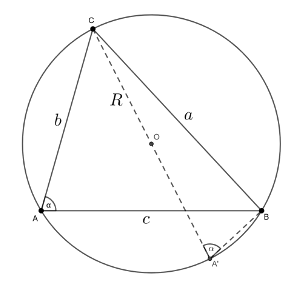
Hello everyone.  Today we will prove the sine theorem.  We will use the method of direct proof as a proof method.  This proof was first constructed by the Persian mathematician Tusi.  Theorem: Let \(a, b, c \) be the sides of any triangle, and \(R \) the radius of the circumscribed circle around that triangle and let the angles \(\alpha, \beta, \gamma \) be the angles opposite the sides \(a, b, c \) , respectively.  Then the following equations hold: \[\frac {a} {\sin \alpha} = \frac {b} {\sin \beta} = \frac {c} {\sin \gamma} = 2R \]  Proof:   Now we will prove that the following equation holds: \(\frac {a} {\sin \alpha} = 2R \).  The equations \(\frac {b} {\sin \beta} = 2R \) and \(\frac {c} {\sin \gamma} = 2R \) can be proved in an analogous way.  Consider the following diagram showing the triangle \(\triangle ABC \) with the circumscribed  circle of radius \(R \). Since angles inscribed in a circle and subtended by the same chor...

Proof of the cosine theorem

Image
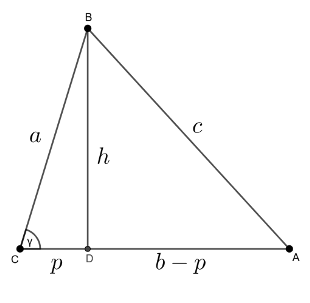
Hello everyone.  Today we will prove the cosine theorem.  We will use the method of direct proof as a proof method.  This theorem was first formulated by the Persian mathematician Kashani.  Theorem: Let \(a, b, c \) be the sides of any triangle and let the angles \(\alpha, \beta, \gamma \) be the angles opposite the sides \(a, b, c \), respectively.  Then the following equations hold: \[c ^ 2 = a ^ 2 + b ^ 2-2ab \cos \gamma \] \[b ^ 2 = a ^ 2 + c ^ 2-2ac \cos \beta \] \[a ^ 2 = b ^ 2 + c ^ 2-2bc \cos \alpha \]  Proof:  We will now prove that the first equation holds i.e. : \[c ^ 2 = a ^ 2 + b ^ 2-2ab \cos \gamma \] Other two equations can be proved in an analogous way.  There are three possible cases, and these are: \(\gamma \) is a right angle, \(\gamma \) is an acute angle, and \(\gamma \) is an obtuse angle.  First case: \(\gamma = 90 ^ {\circ} \)  According to the Pythagoras' theorem, we know that for a right triangle with hypot...

Proof that the central angle of the circle is equal to twice the corresponding inscribed angle

Image
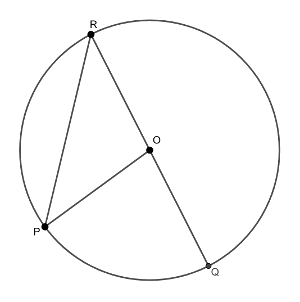
Hello everyone.  Today we will prove that the central angle of a circle is equal to twice the corresponding inscribed angle of the circle.  We will use the method of direct proof as a proof method.  Theorem: The central angle of a circle is equal to twice the corresponding inscribed angle of the circle.   Proof:   We can reformulate the statement as follows:  Let \(P, Q, R \) be three arbitrary points on the circumference of a circle \(k (O, r) \).  Then, \(\angle QOP = 2 \angle QRP \).  We will construct the proof by proving three separate possible cases:  First case: The center of the circle is on a side of the inscribed angle.   We can write the following equations : \[\angle POR + \angle ORP + \angle RPO = 180 ^ {\circ} \] \[\angle QOP = 180 ^{\circ} - \angle POR \] \[\angle ORP = \angle QRP \] Combining the first and second equation we get: \[\angle QOP = \angle ORP + \angle RPO \] Since triangle \(\triangle POR \) is isoscel...

Proof that an integer is odd if its square is odd

   Hello everyone.  Today we will prove that an integer is odd if its square is odd. We will use proof by contraposition as proof method.   Theorem: Let \(n \) be an integer.  If \(n ^ 2 \) is an odd number, then \(n \) is also an odd number.  Proof:   The contrapositive of this statement is: Let \(n \) be an integer.  If \(n \) is an even number, then \(n ^ 2 \) is also an even number.  Let us now prove the contrapositive. Since  \(n \) is an even number, we can write it in the form \(n = 2k \) where \(k \) is an integer.  By squaring this equation we get: \[n ^ 2 = (2k) ^ 2 \] \[n ^ 2 = 4k ^ 2 \] \[n ^ 2 = 2 \left(2k ^ 2 \right) \] Since \(k \) is an  integer then \(2k ^ 2 \) must be an integer due to the closedness of multiplication and exponentiation operations on the set of integers. Denote  \(2k ^ 2 \) by \(r \), then we have \(n ^ 2 = 2r \),  from which we conclude that \(n ^ 2 \) is an even number. Since ...

Proof that an integer is even if its square is even

  Hello everyone.  Today we will prove that an integer is even if its square is even.  We will use proof by contraposition as proof method. Theorem: Let \(n \) be an integer.  If \(n ^ 2 \) is an even number, then \(n \) is also an even number.  Proof:   The contrapositive of this statement is: Let \(n \) be an integer.  If \(n \) is an odd number, then \(n ^ 2 \) is also an odd number.  Let us now prove the contrapositive. Since  \(n \) is an odd number, we can write it in the form \(n = 2k + 1 \) where \(k \) is an integer.  By squaring this equation we get: \[n ^ 2 = (2k + 1) ^ 2 \] \[n ^ 2 = 4k ^ 2 + 4k + 1 \] \[n ^ 2 = 2 \left(2k ^ 2 + 2k \right) +1 \] Since \(k \) is an integer then \(2k ^ 2 + 2k \) must be an integer due to the closedness of addition, multiplication and addition operations on the set of integers. Denote  \(2k ^ 2 + 2k \) by \(l \),  then we have that \(n ^ 2 = 2l + 1 \), from which we conclude that ...

Proof that the square root of a prime number is an irrational number

Hello everyone. Today we will prove that the square root of a prime number is an irrational number.  We will use the method of contradiction as a proof method.  Theorem: If \(p \) is a prime number, then \(\sqrt{p} \) is an irrational number.  Proof:   Suppose the opposite, ie.  that \(\sqrt{p} \) is a rational number.  Then \(\sqrt{p} \) can be written in the form of a fraction \(\frac{a}{b} \), where \(a \) and \(b \) are two coprime integers and \(b \neq 0 \).  By squaring the equation \(\sqrt{p} = \frac{a}{b} \) we get the equation \(p = \frac{a^2}{b^2} \), ie. \(a^2 = pb^2 \).  Let us now write the numbers \(a \) and \(b \) in the form of the product of powers of their prime factors.  \[a = p_1^ {n_1} \cdot p_2^{n_2} \cdot p_3^{n_3} \cdot \ldots \cdot p_j^{n_j} \] \[b = q_1^{m_1} \cdot q_2^{ m_2} \cdot q_3^{m_3} \cdot \ldots \cdot q_k^{m_k} \] Squaring these two equations we get: \[ a^2 = p_1^{2n_1} \cdot p_2^{2n_2} \cdot p_3^{2n_3} \c...

Proof of Archimedes' theorem

Hello everyone. Today we will prove Archimedes' theorem.  We will use the method of contradiction as a proof method.  Theorem: For every two real numbers \(a \) and \(b \) where \(a> 0 \) there exists a natural number \(n \) such that \(a \cdot n> b \).  Proof:   Considering that \(a> 0 \)  we can divide  the inequality \(a \cdot n> b \)   by the number \(a \) so that we get a new inequality \(n> \frac{b}{a} \) .  Let us denote the real number \(\frac{b}{a} \) by \(x \), then we can reformulate the theorem we need to prove as follows:  For any real number \(x \) there exists a natural number \(n \) such that \(n> x \).  Suppose the opposite, ie.  that there exists a real number \(x \) such that \(x \ge n \) for any natural number \(n \).  This would mean that the set of natural numbers \(\mathbb {N} \) is bounded from above.  Let us denote this least upper bound by \(\operatorname{sup}(\mathbb{N...